Showing posts with label Gilts. Show all posts

Friday, 9 October 2009

Why have bond and equity markets been rallying in tandem?

The answer is simple. Equities have rallied BECAUSE bond yields have fallen, reducing the cost of capital and forcing investors to take more risk to maintain their yield. This amounts to a universal carry trade driving everything including corporate bonds, equities and currencies.

Moreover, the fall in long bond yields is being driven by the short end, on which they are anchored. So, as the 2 year yield is squeezed lower by FSA liquidity requirements and lower for longer base rates, longer dated yield shave also benefited from the carry offered by the steepest yield curve in over 20 years. This interplay is demonstrated by the 2's 10's spread, which has remained stable, as the 2 year has hit a record low...

Wednesday, 16 September 2009

Anatomy of a liquidity trap

Liquidity trap: A situation in which prevailing interest rates are low and savings rates are high. As a result, monetary policy is ineffective.

The effectiveness of QE is being compromised by unwillingness on behalf of UK banks to lend. As a result, for every £1 spent on QE, less than £1 is being lent out, which means banks are hoarding the money in order to bolster their balance sheets. This is clearly demonstrated in the charts below, which are based on weekly data from the Bank of England. The first chart shows how a large part of the BoE's ballooning balance sheet has come from reserve balances. The second chart suggests that the cumulative Gilt purchases by the Bank of England have been responsible for the increase in commercial bank reserve balances held at the Bank.


Having initially been about increasing “the amount of money that’s held by the wider economy”, the purpose of QE has been refined by the Bank of England to restoring M4 (ex Intermediate OFCs) growth to 5% per annum. Therefore, the Bank of England acknowledged in the August Inflation Report that QE is not meeting their 5% target:

One potentially useful diagnostic of the impact of the Bank’s asset purchases is the extent to which they boost the stock of broad money. Broad money growth remained weak in Q2. That reflected continued underlying weakness in nominal demand: nominal GDP fell by 3% in Q1, and is likely to have fallen further in Q2. Absent asset purchases, it is likely that money growth would have been even weaker.

Indeed, despite QE, M4 is moving further away from their target...

Given the ineffectiveness of circa £150 billion of Gilt purchases to date, speculation is mounting that the Bank will resort to increasing the QE programme to £200 billion and charging negative interest rates on reserve balances at the BoE in order to boost the money supply and force banks to lend. This, coupled Mervyn King's prognosis of a "slow and protracted recovery", explains why yesterday the two year Gilt yield reached an all time low of 0.74%, Cable sold off two big figures and interest rate futures are pricing in low interest rates will continue for the foreseeable future…

Friday, 19 June 2009

Inflationistas have been smoking too much 'green shoots'!

After the recent deflation scare, inflation expectations have normalised (see chart below of UK 10 year breakeven inflation). Nonetheless, the 'inflation-deflation' debate continues. Indeed, inflationistas such as Marc "Dr Doom" Faber would have us believe that the US is headed towards Zimbabwe-style hyperinflation!


However, while the risk of inflation has certainly increased, fuelled by monetary stimulus and rising commodity prices, to believe that inflation is about to take off requires a large leap of faith. Inflation does not just happen, it requires a transmission mechanism - usually an increase in credit supply. Increased credit supply facilitates increased demand which drives prices higher. However, given we are in a 'credit crunch', it is unlikely that the financial system will provide the transmission mechanism necessary for inflation. Moreover, until house prices trough, there is unlikely to be a recovery in the securitisation market, and therefore credit growth.


Even when the credit taps are turned back on, there is enough spare capacity to absorb increased demand and wage inflation is being kept in check by rising unemployment. Thus, with the output gap in the US at its widest since 1982, it is unlikely that inflation will make a comeback anytime soon.


Finally, if the market is pricing in inflation prematurely, then the additional 250 basis points of risk premium investors can receive by moving out of 2 year Gilts into 10 year Gilts looks extremely attractive. Indeed, the Gilt curve hasn't been this steep since 1992!


Thursday, 7 May 2009

When in trouble, double!


Since the initial announcement and subsequent implementation of QE, Gilt yields have steadily risen (see above chart). Mervyn King has therefore lost money on his £52 billion of Gilt purchases. So, like any punter would do when faced with a loss, big Merv has doubled up.

At today's rate announcement, the Bank of England revealed that it will increase its existing QE facility by an additional £50 billion:
"The Committee also agreed to continue with its programme of purchases of government and corporate debt financed by the issuance of central bank reserves and to increase its size by £50 billion to a total of £125 billion. The Committee expected that it would take another three months to complete that programme, and it will keep the scale of the programme under review."
The 10 year Gilt yield fell 10 basis points. Could this be an inflection point in the 75+ basis point rise in Gilt yields?

Friday, 24 April 2009

Reassessing Gilts: don't panic Mr Mainwaring!

In light of the 30-35 basis point back-up in the 10 year Gilt yield, pushing it above 3.5%, it is time to reassess the investment case for Gilts.


A tumultuous week for Gilts started with Alastair Darling's pre-budget speech, in which he announced the Government will borrow £220 billion this fiscal year, increasing the public debt:GDP ratio from 45% to 76.2% by 2013. This was followed by a Moody's report, How safe are safe havens?, which sent yields higher and Sterling lower, on concerns over the UK's credit rating. Finally, Q1 UK GDP came in worse than expected at -4.1% year-on-year, the worst since 1979.

So, which, if any, of these facts warrant higher Gilts yields?

Increased Gilt issuance
Economic s 1.01 says that, increased supply of a good results in a lower price unless there is a similar rise in demand. However, as the chart below demonstrates, there is little or no relationship between Gilt issuance and Gilt returns. Indeed, the 2008/ 09 financial year saw record gross Gilt issuance of £146.4 billion and the third highest Gilt 12 month total return of 6.8%.


Further proof that bond issuance and returns are not related comes from Japan, where a sustained increase in public debt has been accompanied with a fall in JGB yields.


Moreover, the supply-demand dynamic has shifted in favour of Gilts due the Bank of England's QE programme. The full £100 billion authorised by HMT for Gilt purchases represents 18% of the overall £543.9 billion Gilt market and 45% of the gross issuance this financial year.

These percentages are not small. Indeed, at the end of Q1 2009, the Bank of England had 'only' spent £12.9 billion on Gilts, out of a possible £75 billion. Mervyn King has plenty of firepower left at his disposal with which to mop up new issuance and force yields lower. Thus, to some extent, what the Chancellor giveth, the Bank of England taketh away.


Moody's report
Next, the Moody's report. For all the hysteria it generated, the essence of the report was not as bearish as the market reaction. The conclusion is summarised below:

"Moody's believes that Aaa governments' unconventional policies are defensive responses that are – at best – ratings-neutral if they succeed in kick-starting economic activity. However, if they lead to massive increases in public net debt and a permanent deterioration of debt affordability without tangible growth effects, Moody's cautions that they will be ratings-negative. In extremis, since confidence is not a linear process, these policies could potentially increase 'tail risk', and therefore also the (currently small) risk of sharp rating migration."

Indeed, a spokesman for Moody's confirmed, "the [UK] rating has not changed, and it's not under review for a downgrade. The outlook is stable."


UK GDP
GDP and Gilt returns have a negative correlation, meaning that as GDP falls Gilt returns increase. The chart below demonstrates this by comparing year on year GDP against the 12 month total returns of Gilts.


So, why then was worse than expected GDP cited as a negative for Gilts? The answer could lie in the relative position of the UK versus other developed nations. IMF forecasts for developed nations' GDP are as follows:


The economic outlook for the UK may not be good, but it is no worse than in others countries, indeed, with the exception of the US, it is the best of a bad bunch.

Conclusion
Therefore, it appears that, on balance, nothing has changed the medium term term outlook for Gilts. Yes, inflation is a risk for the longer term, but as the above evidence suggests, none of the developments last week appear to warrant higher Gilt yields.


So, in the immortal words of Corporal Jones, "don't panic Mr Mainwaring!".

Tuesday, 7 April 2009

Why QE will push Gilt yields lower

The fat lady hasn't sung yet and the Old Lady of Threadneedle Street can go on buying Gilts indefinitely until it has the desired effect...


Wednesday, 11 March 2009

QE gets under way

UBS Investment Bank reports:
"The Bank of England embarks on its quantitative easinig effort today with a £2 billion gilt purchase. This will the first of a bi-weekly event that will continue for the next 3 months until the Bank has acquired around £75 billion of gilts and corporate bonds."

Purchases will be made via a reverse auction, in which sellers determine the price that the BoE pays. The Bank will hold only one auction this week, but there will be two per week from next week on Mondays and Wednesdays. The central bank will take non-competitive offers until 12:00 p.m. on auction days, announcing the amount it will allot to such offers at 1:00 p.m.. It will then also publish the size open to competitive offers, and will take bids for that operation between 2:15 p.m. and 2:45 p.m. British time. It will announce the results of that operation soon thereafter.

In today's auction the BoE has specified it wants to buy £2 billion of Gilts maturing from 2014 to 2018. M&G's bond team note, via their blog, Bond Vigilantes:
"The Bank is not buying back sub 5 year paper as part of this programme, as that is where overseas Central Banks (big financers of the UK budget deficit) own gilts, and it could lead to a big reduction in the gilt market's investor base and a possible knock on impact on the £ if overeas investors sold their gilts back to the authorities. Nor is the Bank buying gilts over 25 years in maturity, which would exacerbate the illiquidity in ultra long dated gilts, and possibly cause further problems for pension funds."


Auction results
The reverse auction was 5.25 times subscribed as the BoE receioved offers of £10.5 billion and bought £2 billion. Bull flattening is under way, with the UK 10-2 spread having tightened by 50 bps since the BoE first announced QE on Thursday.

Friday, 6 March 2009

QE in the UK

A new era of monetary policy was ushered in yesterday as the Bank of England embarked on quantitative easing (QE). In the press release that accompanied yesterday's 50 basis point rate cut, the Bank of England confirmed the size and implementation of its quantitative easing programme.

Having received approval from the Chancellor to begin quantitative easing, the MPC voted to begin a programme of asset purchases of £75 billion over three months via the Asset Purchase Facility. This represents the first tranche of an overall £150 billion sanctioned by the Treasury for purchasing of £50 billion of private sector assets (CP & corporate bonds) and up to £100 billion of Gilts, as requested by Mervyn King in recent letter to Chancellor:
"In order to facilitate an expansion of the monetary base through the Asset Purchase Facility, the MPC proposes that gilt-edged securities be added to the list of eligible assets set out in your letter of 29 January. I suggest that the MPC be authorised to use the facility to purchase eligible assets financed by central bank money up to a maximum of £150 billion but that, in line with the current arrangements and in recognition of the importance of supporting the flow of corporate credit, up to, £50 billion of that should be used to purchase private sector assets… If the facility were to be used for monetary policy purposes, I envisage that the Committee would vote each month on a resolution concerning the asset purchases it deemed necessary to meet the inflation target."
What are the implications for the Gilt market? More specifically, which part of the Gilt curve will be impacted most and how does the size of the programme compare to the value of outstanding Gilts?

In their press release, the Bank of England indicated that the majority of the first £75 billion will used to buy Gilts. Purchases will target medium (7-15 year maturities) and long (15+ year maturities) conventional Gilts, as defined by the Debt Management Office (DMO).

The nominal value of all outstanding conventional Gilts is £543.9 billion. The market is segmented between £233.7 billion (43%) in short Gilts, £107 billion (20%) and £203.2 billion (37%) in long Gilts. The first tranche of £75 billion therefore represents 24% of the universe of eligible Gilts of £310.2 billion. The full £100 billion sanctioned for Gilt purchases represents 32% of medium & long Gilts and 18% of the overall Gilt market.

The size of the initial tranche of £75 billion is also substantial in relation to forthcoming net Gilt issuance, representing 58% of the £130 billion expected in the current financial year. Furthermore, the chancellor confirmed that current debt management policy remains in place and there are no plans to change it in light of quantitative easing.

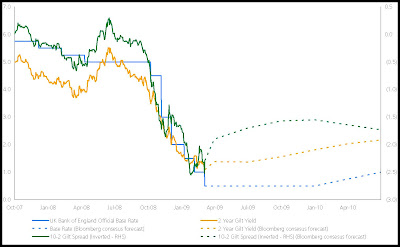
The size of Bank's quantitative easing programme is therefore significant and will have a sizeable impact on the Gilt market. Indeed, the initial 40 basis point rally in 7 to 30 year Gilts following the announcement reinforces this. Going forward, it is likely therefore that the Bank of England's operations will result in a bull flattening of the Gilt curve, as long yields converge on shorter yields. Bull flattening is not only consistent with the Japanese experience of QE in the 1990's, but it has become the consensus forecast for the Gilt curve, as the chart below demonstrates.