Friday, 6 March 2009

QE in the UK

A new era of monetary policy was ushered in yesterday as the Bank of England embarked on quantitative easing (QE). In the press release that accompanied yesterday's 50 basis point rate cut, the Bank of England confirmed the size and implementation of its quantitative easing programme.

Having received approval from the Chancellor to begin quantitative easing, the MPC voted to begin a programme of asset purchases of £75 billion over three months via the Asset Purchase Facility. This represents the first tranche of an overall £150 billion sanctioned by the Treasury for purchasing of £50 billion of private sector assets (CP & corporate bonds) and up to £100 billion of Gilts, as requested by Mervyn King in recent letter to Chancellor:
"In order to facilitate an expansion of the monetary base through the Asset Purchase Facility, the MPC proposes that gilt-edged securities be added to the list of eligible assets set out in your letter of 29 January. I suggest that the MPC be authorised to use the facility to purchase eligible assets financed by central bank money up to a maximum of £150 billion but that, in line with the current arrangements and in recognition of the importance of supporting the flow of corporate credit, up to, £50 billion of that should be used to purchase private sector assets… If the facility were to be used for monetary policy purposes, I envisage that the Committee would vote each month on a resolution concerning the asset purchases it deemed necessary to meet the inflation target."
What are the implications for the Gilt market? More specifically, which part of the Gilt curve will be impacted most and how does the size of the programme compare to the value of outstanding Gilts?

In their press release, the Bank of England indicated that the majority of the first £75 billion will used to buy Gilts. Purchases will target medium (7-15 year maturities) and long (15+ year maturities) conventional Gilts, as defined by the Debt Management Office (DMO).

The nominal value of all outstanding conventional Gilts is £543.9 billion. The market is segmented between £233.7 billion (43%) in short Gilts, £107 billion (20%) and £203.2 billion (37%) in long Gilts. The first tranche of £75 billion therefore represents 24% of the universe of eligible Gilts of £310.2 billion. The full £100 billion sanctioned for Gilt purchases represents 32% of medium & long Gilts and 18% of the overall Gilt market.

The size of the initial tranche of £75 billion is also substantial in relation to forthcoming net Gilt issuance, representing 58% of the £130 billion expected in the current financial year. Furthermore, the chancellor confirmed that current debt management policy remains in place and there are no plans to change it in light of quantitative easing.

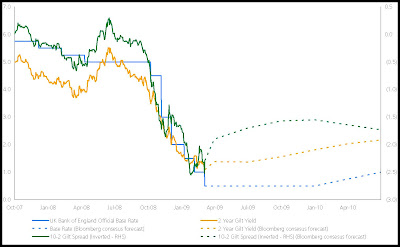
The size of Bank's quantitative easing programme is therefore significant and will have a sizeable impact on the Gilt market. Indeed, the initial 40 basis point rally in 7 to 30 year Gilts following the announcement reinforces this. Going forward, it is likely therefore that the Bank of England's operations will result in a bull flattening of the Gilt curve, as long yields converge on shorter yields. Bull flattening is not only consistent with the Japanese experience of QE in the 1990's, but it has become the consensus forecast for the Gilt curve, as the chart below demonstrates.

Wednesday, 4 March 2009

Caught between a rock and a hard place

Shareholders are caught between between dividend cuts and rights issues in what is effectively a liquidity squeeze. As if reduced cash flows from dividends wasn't bad enough, investors are also being asked to cough up more cash by companies issuing new shares.

In the UK alone, Threadneedle forecast £50 billion of equity issuance by UK companies 2009, more than double the £23 billion issued in 2008.

The outlook for dividends is equally bleak. Standard & Poor’s forecasts the worst year for dividend cuts since 1938 for US investors. S&P forecast dividend pay-outs for 2009 to drop at least 22.6%, since cash flow is crucial for companies and their need to conserve cash will outweigh their desire to pay dividends.

Moreover, having principally affected financials, who were responsible for £16.9 billion of the total £23 billion raised from rights issues in the UK in 2008, the list of sectors issuing new shares and slashing dividends has grown considerably in 2009. Indeed, BP, whose dividends accounted for over 11% of the total dividends paid by FTSE All Share companies, is expected to freeze its dividend this year for the first time since 1999.

Investor appetite for forthcoming rights issues is likely to be severely tested. Indeed, following another new low in equity prices, investors will be wondering whether they should throw yet more good money after bad. Indeed, the investment banks who are underwriting the rights issues are charging 50% more in fees to compensate them for the risk of being left with a large rump in volatile markets.

Monday, 2 March 2009

Banking on dividend cuts

Following the recent dividend cuts from financials such as HSBC and JP Morgan, who have cut their dividends by more than 80%, the forward looking yield on major equity indices is likely to be reduced significantly due to the large weighting of financials within these indices. For example, financials make up 30% of the €Stoxx 50 index and they contribute circa 50% and 30% of the index's historic and projected yield. Whilst this suggests that the market has already factored in dividend cuts, any further cuts, of say 50%, could reduce the index's dividend yield by 1%, from 6.5% to 5.5%.


Friday, 27 February 2009

The relative illusion of USD safety

Like GBP, EUR, CHF & now JPY before it, the USD is bowing under the juxtaposed twin pressures of a strong demand for its currency and horrendous fundamentals (note Obama's forecast for a balooning deficit of $1.75 trillion) . When it cracks what will replace it... gold? The gold bulls would have us believe that in a world of fragile confidence, this is the only true store of value. Whilst any USD weakness is likely to boost gold it may also signify capitulation and the realisation that safety is only relative and not absolute.


However, judging by recent comments by a Chinese official, the US Treasury can count on its best customer, China, to continue to purchase Treasuries, even if the USD does depreciate:


"Except for US Treasuries, what can you hold?” he asked. “Gold? You don’t hold Japanese government bonds or UK bonds. US Treasuries are the safe haven. For everyone, including China, it is the only option… We hate you guys. Once you start issuing $1 trillion-$2 trillion… we know the dollar is going to depreciate, so we hate you guys but there is nothing much we can do."

http://ftalphaville.ft.com/longroom/tables/equity-strategy/the-relative-illusion-of-usd-safety

http://ftalphaville.ft.com/blog/2009/02/26/52909/bny-mellons-fx-team-ultimately-buy-gold/

Wednesday, 25 February 2009

Gilts: bank liquidity + QE = bull flattening

Two recent developments imply bull flattening of the Gilt curve...

First, Morgan Stanley estimate that UK banks will be forced to buy up to £100 billion of Gilts in 2009, following the announcement of FSA’s new liquidity regime . This compares to a total Gilt market size of about £480 billion as at end-2008, and planned net Gilt issuance this financial year of about £130 billion.

Banks will be required to hold Liquid Asset Buffer portfolios, consisting of a combination of Gilt holdings stretching far out along the yield curve, with perhaps some of the duration risk hedged by interest rate swaps. Moreover, the steep Gilt curve gives a strong incentive to put more long-dated Gilts in the portfolio, despite their higher volatility.

Second, the MPC unanimously voted to seek authority to embark on quantitative easing (see February MPC minutes) in the form of buying government and other securities, financed by the creation of central bank money using the Asset Purchase Facility. The BoE believes that these measures are required in order to prevent CPI undershooting it's 2% target until 2012. The size of this QE program is rumoured to be £100-150 billion.

Both these developments imply bull flattening as a possible £250 billion of Gilts are purchased, forcing a compression in longer dated yields. Moreover, this is more than enough to soak up all of the expected £130 billion issuance for the current financial year.

Some links to articles demonstrating the above:

http://ftalphaville.ft.com/longroom/tables/fixed-income/gilts-bank-liquidity-qe-and-bull-flattening/

FX: Bullish USDJPY & other trends

  • USDJPY reversing gains. Japan is export driven economy & therefore sensitive to JPY. The more JPY rallies, the more the Japanese economy is likely to deteriorate (e.g. -12% GDP Jan & Jan exports -46% YoY) and the more likely the BoJ intervene, both of which make JPY less attractive.
  • The state of the US economy & the debt burden puts $ hegemony at risk in the long term. The US is a net borrower (current a/c deficit -5% GDP) and a net debtor (70% of GDP by 2010) while fiscal deficit -3.5% and rising. Moreover, the countries that fund the deficit are strategic rivals/ unstable petro-states and their reserves are being diverted to fixing their domestic economies. The US is vulnerable to the kindness of strangers.
  • A large part of $ safe haven status is technical, driven by flight to US Treasuries & countries/ companies that funded themselves in $ who can't refinance debt.
  • EUR: Asked whether Germany would risk seeing the Eurozone break up rather than take action if one of the member states could not refinance its debt, Peer Steinbrück, finance minister, told a press conference: “Could you imagine anyone would be willing to put up with this? We would have to take action.”
  • £ concerns overdone:
    1. public debt = 55% of GDP & 70% by 2010 but < 1916-1970
    2. UK not only country increase public debt:GDP ratio. UK's 70% of debt:GDP = Germany, < France/ US
    3. Nationalisation of banks risky but falling GBP offsets foreign liabilities on bank balance sheets
    4. UK default assumes inability of state to manage economy

Government Bonds: Bulls vs. Bears

Bullish: Falling interest rates, deflation, quantitative easing (QE), flight to safety = bullish flattening for yield curves (see Japan below)


BoE Jan minutes show MPC unanimously agreed that Mervyn King, governor, should seek authority for purchases of gilts and other securities in an effort to broaden the money supply. The Bank of England believes that inflation will undershoot the target until 2012 unless it engages in quantitative easing. Implementation rumoured £10-15bn over next 3 months.


Barcap revised Bank of England rate view & expect Bank rate to be cut by 50bp at the March meeting to 0.50% then leave policy rates unchanged as it embarks on a programme of QE. Barcap no longer expect a back-up in gilt yields (forecast bottom @ 3.25% Q3 '09 vs. Bloomberg consensus 3.13%) in the second half of 2010. Barcap expect any tightening cycle commencing in 2011 to be relatively cautious.

China held $696bn of US Treasuries in Dec 08. Luo Ping, a director-general at the China Banking Regulatory Commission, said that China would continue to buy Treasuries in spite of its misgivings about US finances: “Except for US Treasuries, what can you hold?” he asked. “Gold? You don’t hold Japanese government bonds or UK bonds. US Treasuries are the safe haven. For everyone, including China, it is the only option… We hate you guys. Once you start issuing $1 trillion-$2 trillion… we know the dollar is going to depreciate, so we hate you guys but there is nothing much we can do.”

Bearish: Risk premiums very low – return-free risk – don't adequately compensate investors for risks: CPI & record issuance. Turning a blind eye to fundamentals or risk, is a good indicator of a bubble.


Increased issuance will put pressure on FX & yields (e.g. US 10yr +1% YTD on record issuance announcement). However, a degree of inflation is beneficial, since it will reduce the debt burden
In recent years, demand for US government debt has been stoked by developing countries running huge trade surpluses with the US and recycling dollars by buying Treasuries. However, many are facing growing pressure to stimulate their own economies and are seeing their current account surpluses decline as global demand diminishes.


Index linked markets attractive (despite recent rally in BEIs) as only LT risk free asset. Whilst deleveraging in the short term ≠ CPI. However, the further interest rates fall in the short term, the greater the risk of inflation in the medium to long term. Thus, at some point, assuming the stimulus has the desired effect of reflating the economy, inflation will rise again, possibly in an aggressive manner. Moreover, given that the stimulus is funded by record amounts of government borrowing, yields are likely to respond in kind to both rising inflation and issuance as investors demand a higher risk premium. Indeed, it is possible that governments and central banks may wish to induce a period of above target inflation in order to reduce the public and private debt burden.


UK 10yr BEI 2.1% = just over BoE CPI target & risk to upside.